Watt Lighting School - an opportunity to understand light, its basic concepts and gain new knowledge!
The Watt Lighting School is also visited by retail chain representatives, together with whom we carry out luminaire tests and comparisons between the products of different manufacturers. We study general lighting, the angle and specifics of light incidence, specialised lighting for various food product groups and many other important factors, giving clients the opportunity to find the most advantageous and suitable solution for themselves.
At the Lighting School we also introduce innovations, trends and the latest technologies in lighting. We have been visited by representatives of manufacturers such as Modula, Zumtobel and Philips, who introduced Watt clients, students and other interested parties to the latest technology and its development directions.
Let's experiment with light together!
Lighting School tips:
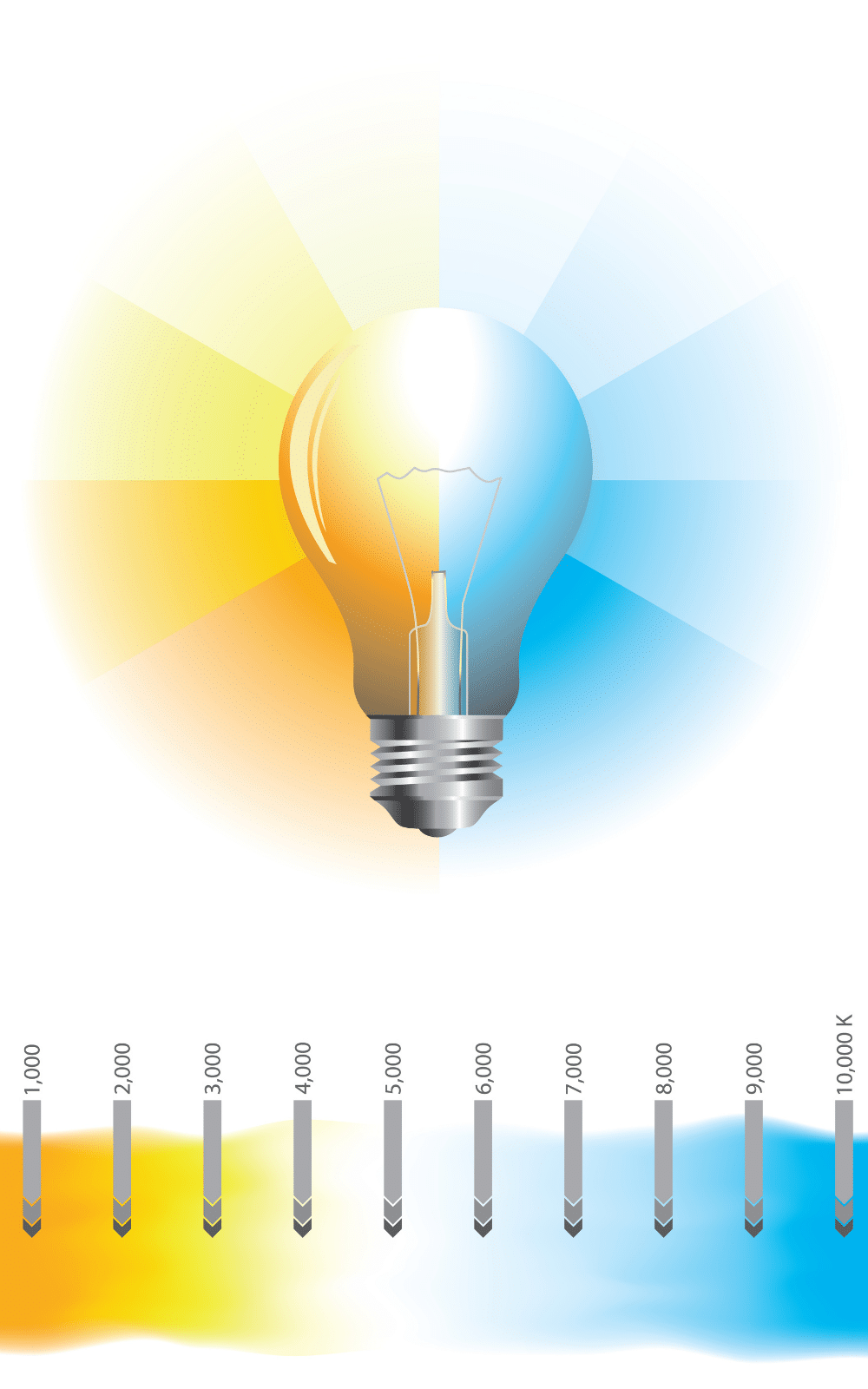
What is colour temperature?
In our everyday life we are used to incandescent bulbs intended for living spaces. These bulbs give off 2700K, creating a cosy atmosphere and a sense of warmth. E27 bulbs mostly also have this spectrum. In nature this spectrum is visible shortly after sunrise and before sunset. We recommend choosing this lighting in the bedroom as general lighting and in the living room as decorative lighting.
Modern LED technology also offers a considerably warmer spectrum, down to 2000K , which produces a very warm, orange light. However, it should be noted that indoors, under such lighting, white surfaces may take on a yellowish tint.
Also gaining in popularity is white light 3000-4000K. In nature this spectrum occurs in the morning. These spectra are usually used in workplaces (offices, laboratories, warehouses). With this spectrum, the light output from the luminaire will be considerably greater than with the warm spectra, providing more light. 3000K we would recommend using in the living room as general lighting, in the kitchen, the bathroom and the workspace. White light invigorates and gives extra energy. 4000K is a good solution for the bathroom, because this way it is possible to achieve more light and the room looks visually cleaner, the tiles - whiter.
Cold light 5000-6500K is found in nature when the sun is at its zenith. It is usually used in hospitals, laboratories and warehouses. We generally do not recommend using this spectrum in living spaces.
There are also even colder spectra: 6500K > up to 12000K. They are used in specialised environments, for example, in aquariums.
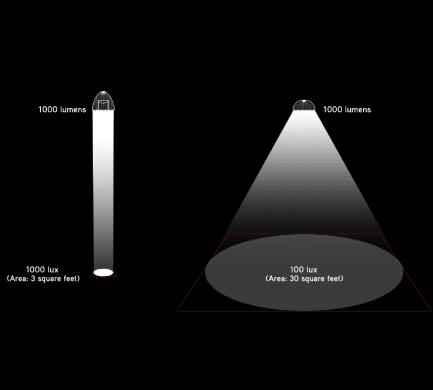
What is lux?
Lux is the unit of measurement of light, denoting the intensity of light on a surface (lumens per square metre, lx = lm/m2). This unit is most often used in lighting calculations to determine the intensity of light in spaces on a horizontal plane.
In living spaces, usually no more than 400lxis exceeded. Typically they start from 100lx (WC), 200lx (bedroom), 300-400lx (bathroom, kitchen and living room). However, this may vary depending on each person's individual understanding and preference for how bright or dark a particular room needs to be.
What is the colour rendering index (CRI)?
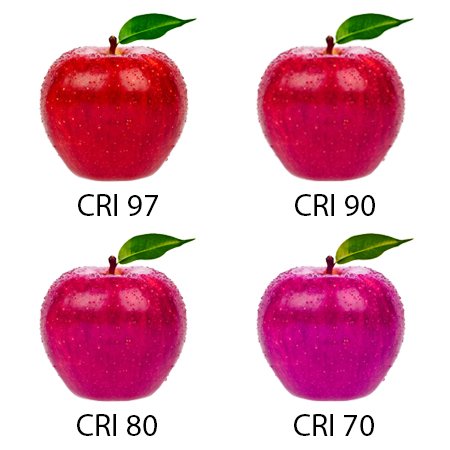
The colour rendering index, denoted by Ra or CRI, shows how accurately artificial lighting reproduces colours compared with daylight. The closer the number is to 100, the more realistic the colours are.
Lighting mounted on poles in car parks and along the edges of streets usually has a colour rendering of Ra>70. This index shows that colours are not reproduced at high quality, because in such conditions this is also not necessary. In the household this index will usually not be encountered.
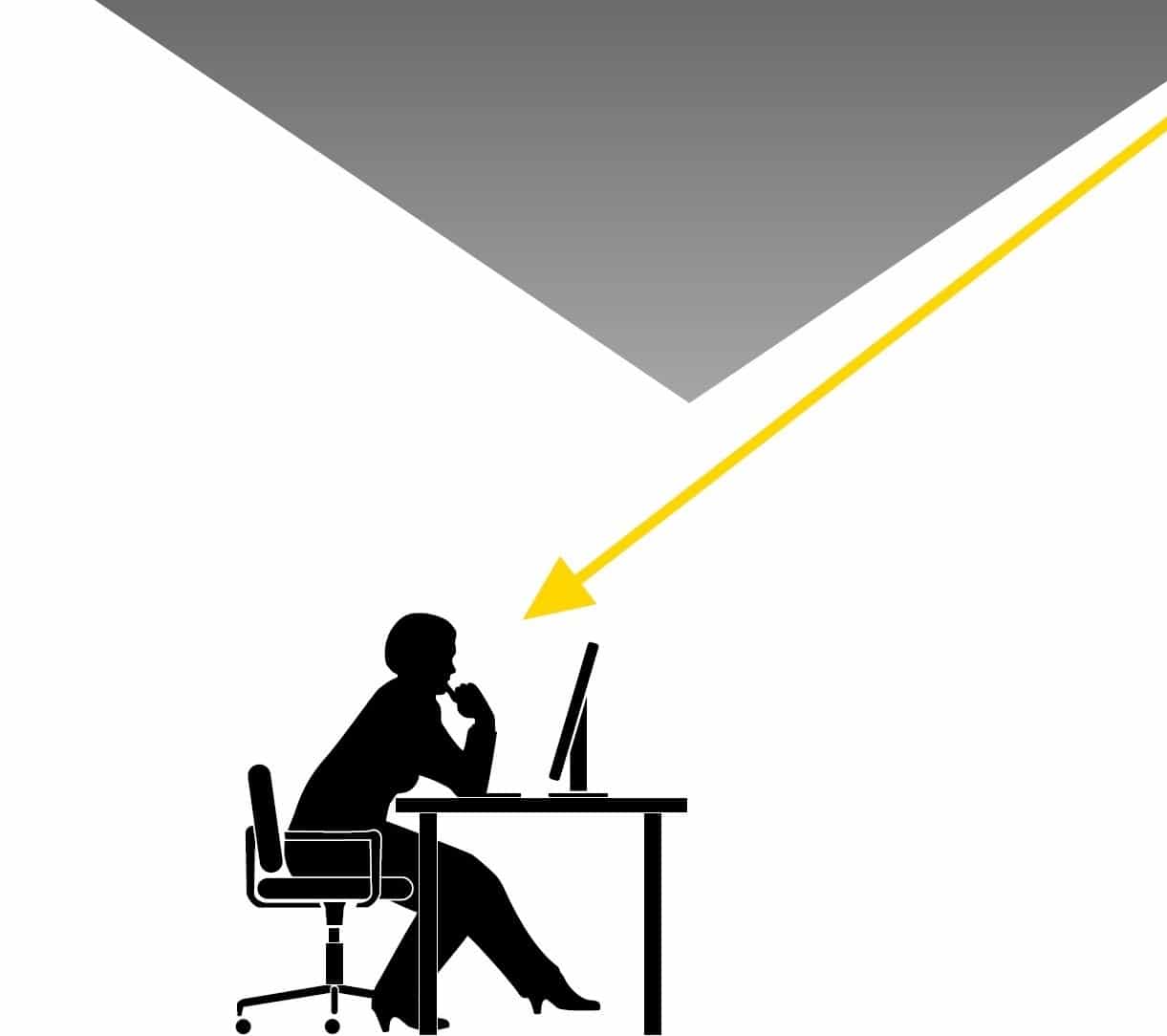
What is the glare rating (UGR)?
UGR is a parameter denoting the degree of glare - the higher the number, the more strongly it will glare.
This parameter is mainly used in professional lighting, where in workplaces (offices, schools, etc.) UGR<19, whereas in corridors and stairwells it must not, by standard, exceed UGR<25. In retail spaces and warehouses this value must be lower than UGR22.
In offices this UGR level is usually provided by a micro-prismatic diffuser built into the luminaires, which refracts the light rays emitted from the LED diode and ensures that, instead of a single strong beam, the light is evenly diffused across the entire surface of the diffuser. Thanks to this, the light becomes softer and more pleasant to our eyes, without creating too much strain and fatigue.
The glare factor does not usually apply directly to households, but when choosing a luminaire and a bulb it is important to understand where it will be located and whether it will create an unpleasant effect. For example, a luminaire hung low over the dining table with a strong clear-glass bulb will dazzle our vision. In such cases we recommend considering a frosted bulb or a luminaire that does not have an open bottom but is instead filled with frosted organic glass. A diffuser will help to scatter the light and make it even, similar to what a micro-prism does in technical luminaires. The same applies to lighting by a mirror, where you should choose a luminaire with a frosted light source. If you choose an exposed light source, it will additionally be reflected off the mirror and create a strong glare effect.
What is luminous efficacy (lm/W)?
This value denotes the amount of light output per watt consumed. The higher the number, the more energy-efficient the luminaire. Nowadays we can consider a luminaire economical if this ratio is greater than 100lm/W.
For technical luminaires the index reaches as much as 180lm/W, providing very high energy efficiency. Most often it is within the range of 90-130lm/W.
For outdoor and façade luminaires the energy efficiency is lower, in the range of 70-90lm/W.
Given consumers' wish to save and choose energy-efficient solutions, most LED bulbs and luminaires intended for households have a fairly good lm/W ratio, thereby ensuring efficient use of electricity in lighting.